AIDS 2026: What the world's biggest HIV conference actually told us.
August 2026 · 12 min read
Every two years, the people actually working on the HIV response — researchers, clinicians, community leaders, people living with HIV — gather for six days to compare notes on what's working, what's failing, and what's coming next. This year's conference, AIDS 2026, ran across more than 150 sessions and 2,400 research posters, against what the IAS itself described as a "tumultuous funding and geopolitical backdrop" that has reshaped the global HIV response.
We went through the key findings so you don't have to wade through 150 sessions yourself. Here's what actually matters, especially if you're reading this in Nigeria.
The funding cuts are not an abstraction anymore
Eighteen months after US aid funding and policy changes disrupted the global HIV response, the data presented at AIDS 2026 confirmed what many organisations on the ground already knew: the damage is real and measurable.
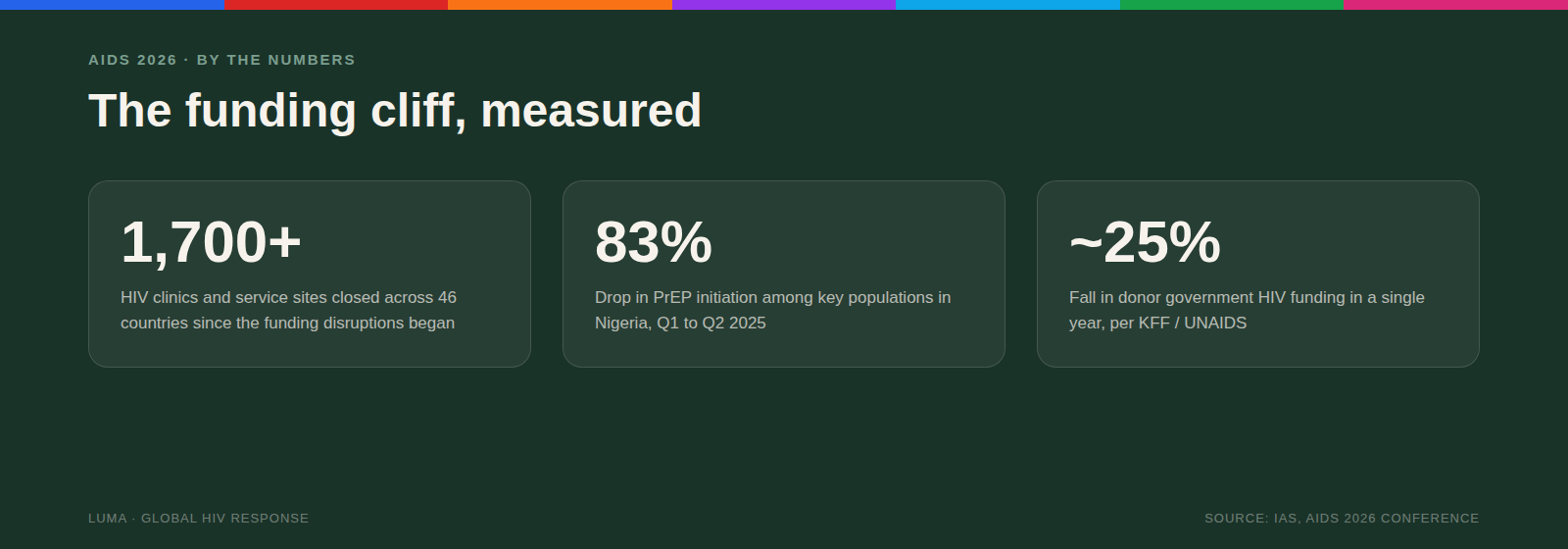
Across 46 countries, more than 1,700 HIV clinics and service delivery sites have closed, most heavily concentrated in eastern and southern Africa, and disproportionately affecting key populations who already faced the steepest barriers to care. Tens of thousands of health workers have lost their jobs or face losing them across the countries studied.
The numbers coming out of Nigeria specifically are stark. Between the first and second quarter of 2025 alone, prevention services reached over 50% fewer people in key populations, HIV self-testing dropped by more than 70%, and PrEP initiation among key populations fell by 83%.
Donor government funding for HIV fell by roughly a quarter in a single year, according to a joint report from KFF and UNAIDS presented at the conference. At the same time, domestic financing — money African and other governments are putting into their own HIV responses — rose, and now makes up close to 60% of total global HIV funding. UNAIDS Executive Director Winnie Byanyima put it plainly at the conference: "The era of relying on international aid is over."
A new model of leadership and partnership
The funding crisis exposed something the HIV response had quietly depended on for years: a governance structure built around one dominant donor. AIDS 2026 heard growing consensus that recovery depends on spreading that dependence out, not replacing it with another single source.
Researchers presented six alternative paths forward, including coalitions of donors from the Global South, solidarity taxes, and folding HIV services directly into national health systems rather than running them as separate, donor-dependent programmes. Cutting costs through telemedicine and local production of generics came up repeatedly as part of what sustainability actually looks like after 2026.
A cross-regional review found that weak transition planning and shrinking space for civil society to operate were consistently the biggest threats to keeping people on treatment during funding shifts. The clearest recommendation to come out of this research: build the leadership of people actually living with HIV directly into national sustainability planning, not as an afterthought.
Funders are also shifting toward what's being called "catalytic capital", using smaller amounts of funding to unlock larger pools of public and private money, rather than trying to fund everything directly. But delegates were clear that no single partnership model works everywhere. What works depends on culturally relevant communication and genuine community engagement, not a template applied uniformly.
Prevention is becoming something people actually want to stay on
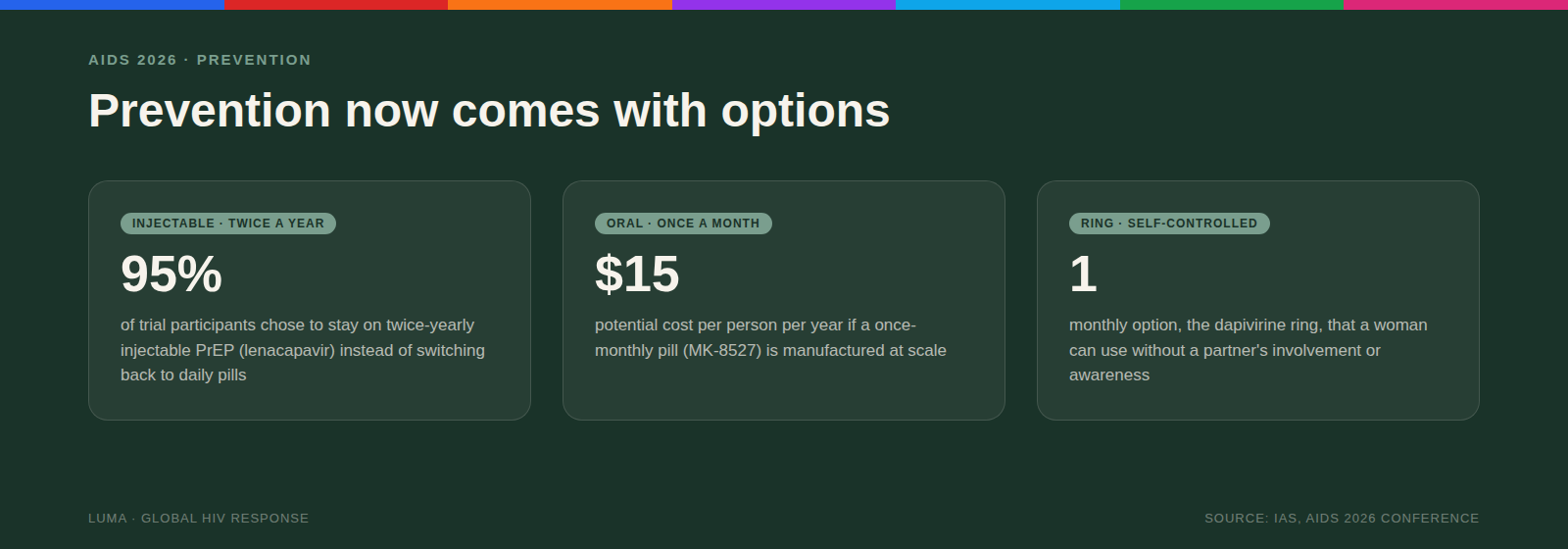
One of the clearest wins to come out of AIDS 2026 was long-acting prevention. Twice-yearly injectable PrEP (lenacapavir) showed remarkable real-world uptake — in trials spanning eight countries, 95% of participants chose to continue with it rather than switch back to daily pills. Participants cited convenience and a real reduction in the stigma and daily burden that comes with taking a visible pill every day.
Choice is expanding on multiple fronts. Modelling presented at the conference suggested a once-monthly oral option (Merck's MK-8527) could potentially be mass-produced for around $15 per person per year if scaled. A dapivirine vaginal ring, controlled entirely by the user, offers another monthly option, particularly relevant for women who want prevention without needing a partner's involvement or awareness.
Early rollout data from Zambia and Eswatini showed lenacapavir successfully reaching PrEP-naive clients, adolescent girls, and key populations — exactly the groups prevention programmes most often struggle to reach. In Uganda's Nakivale refugee settlement, the first humanitarian study of the drug's acceptability described it as life-changing for displaced people dealing with conflict and constant movement.
But access remains deeply uneven. Brazil's Minister of Health noted that even though Brazil hosted part of the clinical trials for these drugs, the country still faces real questions about affordable access to them. His comment on this captured the tension well: innovation that never reaches the people it was tested on isn't really innovation.
Treatment is getting simpler too
Alongside prevention, treatment itself is moving toward less daily burden. Early results from trials of a combined oral treatment (islatravir/lenacapavir) suggest it could become the first once-weekly oral HIV treatment, tested across more than 1,200 people living with HIV across Asia, Australia, Europe, the Americas, and South Africa. Early data shows it working effectively and being well tolerated in people whose HIV is already suppressed.
Cure research: slow, but not stalled
Two more people were reported in sustained HIV remission at AIDS 2026, bringing the global total to 13 documented cases. Both achieved remission through stem-cell transplants, procedures that were medically necessary for other reasons (typically cancer) and not something available as a general HIV treatment. Still, each case gives researchers a real, if narrow, window into what a broader cure might eventually require.
A long-running South African study following 79 adolescents who acquired HIV at birth and started treatment in infancy found that nearly one in five still showed signs of HIV activity in the central nervous system, despite the virus being suppressed in their blood. That's a meaningful finding for how future cure research gets monitored — blood tests alone may not tell the whole story.
Researchers are also exploring broadly neutralizing antibodies, a different approach that works with the immune system directly rather than suppressing the virus the way standard treatment does, as a possible path toward longer periods of viral control without daily medication.
Vaccine research is making real, if incremental, progress
HIV vaccine development has always been difficult, largely because the virus is unusually good at directing the immune system toward useless, non-protective responses. Several studies presented at AIDS 2026 showed real progress in getting around this.
One study found that antibody-producing cells initially pointed in the wrong direction could actually be redirected mid-course toward a genuinely protective target, through carefully sequenced vaccine doses. Another approach removed a small segment of HIV's outer protein from a vaccine candidate, which shifted the immune response to something calmer and less inflammatory, and cut infection risk in animal trials by more than 80%, enough to move toward the first human trial of that design. A third approach used an mRNA-based first dose to prime the immune system before follow-up doses, similar in concept to the platform behind COVID-19 vaccines, showing strong early immune response in animal testing.
None of this means a vaccine is imminent. But after years of difficult, often disappointing vaccine research, the direction of travel presented at AIDS 2026 was genuinely encouraging.
AI and digital tools are reaching people conventional systems miss
Some of the most interesting innovations presented weren't pharmaceutical at all. In China, where late HIV diagnosis has historically been a major problem, an AI-powered self-testing device that reads results and securely shares them to the cloud is now letting partners of newly diagnosed people test privately while still connecting positive results to care. Piloted across 17 provinces, it measurably caught infections earlier than before.
Closer to home, communities in Nigeria's Niger Delta, where getting routine antiretroviral refills to riverine, hard-to-reach areas has always been a major logistical challenge, are now receiving medication and supplies by drone. Early results from the pilot reported a 100% successful delivery and pickup rate among the children and adolescents involved.
Sessions at the conference also pushed for responsible guardrails around AI use in HIV programmes, a reminder that new tools still need real oversight, not just enthusiasm.
Children remain the most overlooked group in the response
Progress for children living with HIV was mixed. An audit of infants in Uganda who acquired HIV from their mothers found ongoing gaps in retesting and viral load monitoring, gaps that are largely preventable with better follow-up systems.
On the treatment side, there were real advances: a once-daily single-tablet regimen proved safe and effective over five years in children, and a larger trial found that a long-acting injectable given every eight weeks outperformed daily oral treatment in adolescents, and was strongly preferred by the young people taking it.
But funding cuts are already undoing progress here too. PEPFAR-supported data showed over 77,000 fewer children on treatment in a single year, a 14% decline. And as the first generation of children born with HIV and treated from infancy reaches adulthood, a UK-based study found that more than 70% of them now live with a metabolic condition, a signal that long-term, lifelong HIV care needs to include early screening for conditions well beyond the virus itself.
Care works better when it isn't delivered in isolation
A theme that came up again and again at AIDS 2026: HIV outcomes improve when care is integrated into other health services people are already accessing, rather than treated as a separate system.
Studies on tuberculosis, which remains a leading cause of death among people living with HIV, found that treatment interruptions and unsuppressed viral loads significantly raise the risk of developing TB, and that TB relapse after treatment is a strong predictor of death, meaning "completed treatment" should really be treated as a checkpoint requiring continued monitoring, not a finish line.
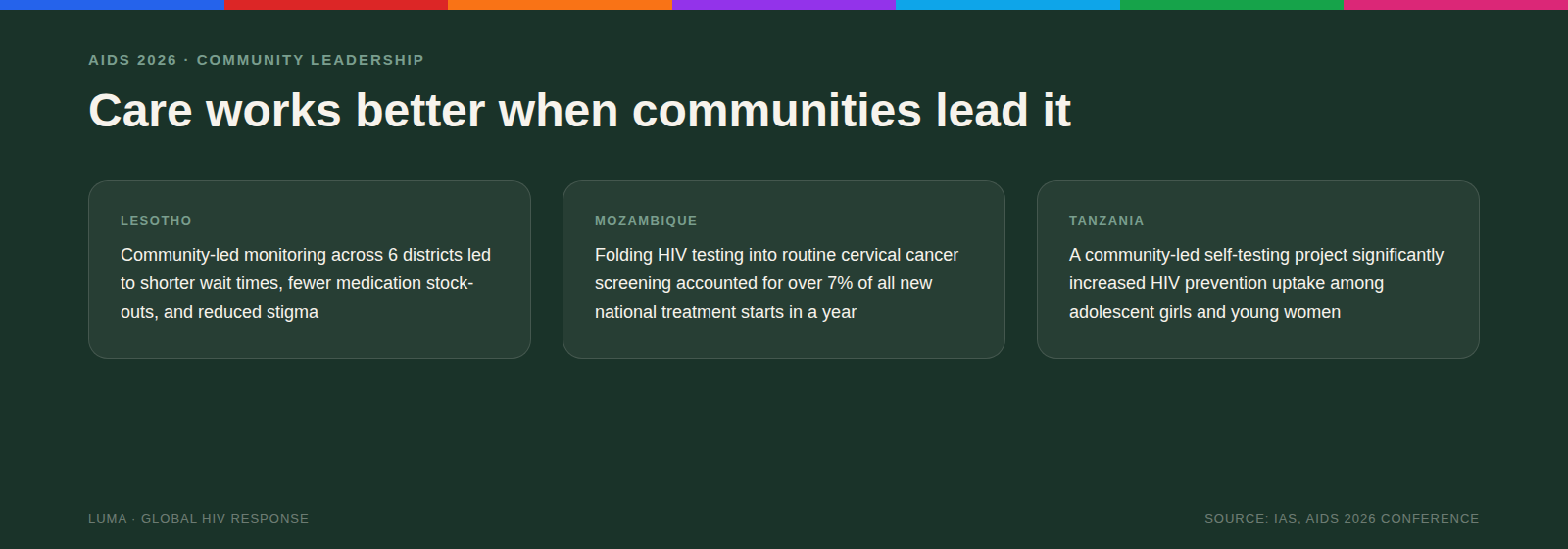
Elsewhere, integration showed clear, practical results. In Mozambique, folding HIV testing into routine cervical cancer screening accounted for over 7% of all new national HIV treatment starts in a single year. In Botswana, integrating hypertension care into HIV clinics improved how much patients trusted their providers. Combined testing models, covering HIV, STIs, cervical cancer, and hepatitis together, consistently improved how many people actually got tested and diagnosed across the African and Asian sites studied.
Communities that lead get better results than communities that receive
Across many of the conference's strongest findings, one pattern held: HIV responses led by the communities they serve consistently outperform top-down models, and yet community-led programmes remain some of the most fragile when it comes to funding.
In Brazil, Nigeria, Indonesia, and Lesotho, communities are increasingly shifting from simply receiving services to actively monitoring quality, challenging barriers to medication access, and documenting rights violations — work that improves accountability and measurably reduces stigma. In Lesotho specifically, community-led monitoring across six districts was linked to shorter wait times, fewer medication stock-outs, and reduced stigma.
Community-led approaches also reached people conventional health systems consistently miss. In Colombia, a peer-led programme for Venezuelan migrants combined testing, peer navigation, and legal support, improving diagnosis and treatment outcomes despite migration status and exclusion from formal health insurance. In Tanzania, a community-led self-testing project for adolescent girls and young women significantly increased uptake of HIV prevention services.
Stigma and criminalization are still actively undermining health outcomes
In a political climate the conference described as marked by rising conservatism and backlash against rights, stigma and criminalization were presented not as unfortunate side effects, but as structural forces actively working against the HIV response.
The HIV Justice Network presented evidence that criminalizing HIV transmission or exposure deters testing and delays treatment — the opposite of what these laws are typically claimed to achieve. A similar pattern showed up around drug policy in Latin America, where over half of people surveyed reported an arrest that directly interrupted their HIV care, with non-binary and trans people facing the most harassment.
These pressures compound. In Uganda, following the 2023 Anti-Homosexuality Act, nearly a third of men who have sex with men screened positive for moderate-to-severe depression. After the 2025 HIV funding freeze added another layer of instability, that number rose to 44%, and reported suicidal ideation rose from 15% to 24%. Legal and financial shocks don't just affect access to medication — they affect mental health at a population level.
Conflict changes everything, and resilience has to be built in advance
Two very different conflict settings offered a clear lesson in preparation. In Sudan, civil war beginning in 2023 caused HIV testing to drop by as much as 78%, with positivity rates rising sharply among those who could still access testing. Treatment coverage collapsed by nearly 60% before partially recovering through redistribution to more stable areas.
Ukraine tells a different story. Well before Russia's full-scale invasion in 2022, Ukraine had already begun shifting its HIV response from donor-funded pilot programmes into permanent national public financing. That groundwork paid off: even during active war, over 97% of people newly enrolled in Ukraine's national HIV programme in 2024 were still on treatment in early 2026.
The takeaway researchers kept returning to: decentralised, nationally-owned systems hold up under shock far better than donor-dependent ones. A related session drawing on data from Uganda, Kenya, East Africa, Nigeria, and Fiji reinforced that violence, food insecurity, and funding instability shape HIV outcomes as powerfully as war does — evidence that these outcomes come from overlapping social and economic conditions, not individual behaviour.
Why this matters for LUMA
Nearly everything AIDS 2026 confirmed is something LUMA has been building toward from the start: that the right information, delivered without shame attached, changes outcomes. That communities who lead their own health response do better than communities who are simply managed. That stigma, not the virus itself, is often the actual barrier standing between a young person and the care they need.
The science is moving fast — longer-lasting prevention, real cure research, better treatment options. But as more than one speaker at AIDS 2026 pointed out, none of it means anything if the people who need it don't know it exists, or are too afraid of judgment to ask.
Source: International AIDS Society (IAS), AIDS 2026 Conference. This article summarises and paraphrases findings presented at the conference; for full session details and original abstracts, visit programme.aids2026.org.
Found this useful?
Continue Reading
More from the Campus Truth Series
You cannot get HIV from sharing a classroom. Here is what the research says.
5 min read
Read
What is PrEP and why does no one at your campus health centre mention it?
7 min read
Read
HIV stigma at Nigerian universities: what our data found and why it matters.
6 min read
Read